
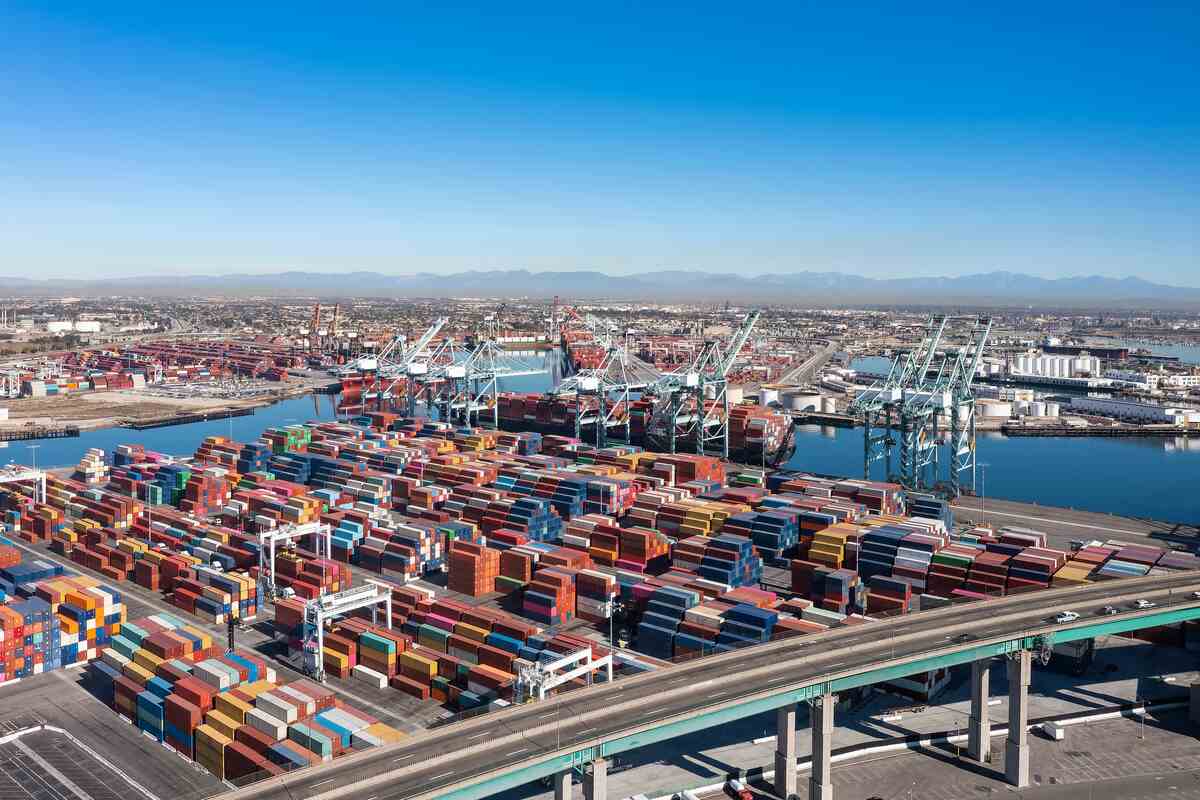
The U.S. trade deficit widened sharply in May as imports climbed to a 14-month high, underscoring the continued impact of trade on economic growth during the second quarter despite resilient domestic demand.
According to new data released by the Commerce Department’s Bureau of Economic Analysis and the Census Bureau, the trade gap expanded 42.2 percent to $77.6 billion, the highest level since March 2025. The figure was slightly below Reuters economists’ forecast of $78.5 billion but reflected a substantial deterioration in the trade balance.
The increase was driven by a surge in imports, particularly capital goods, as businesses sought to secure supplies ahead of potential tariffs and avoid shortages and higher costs linked to the conflict in the Middle East. Overall imports rose 3.3 percent to $395.3 billion, their highest level since March 2025, while goods imports increased 4.0 percent to $317.0 billion, the strongest reading since April 2025.
Despite concerns that rising imports will continue to weigh on gross domestic product (GDP), economists noted that the sustained strength in inbound shipments also signals healthy domestic demand, as reported by Reuters. Investment in artificial intelligence infrastructure has become a major driver of capital goods imports, while the strong U.S. dollar has also supported higher import volumes. The widening deficit came despite President Donald Trump’s tariff policies, which were introduced to reduce the trade imbalance and support domestic manufacturing.
Earlier this year, the U.S. Supreme Court struck down portions of the tariff regime, prompting the White House to introduce a new global duty while proposing additional Section 301 tariffs. The administration has maintained that tariffs remain an essential tool to narrow the trade deficit and strengthen American industry.
AI boosts imports
Capital goods imports rose by $1.1 billion to a record $128.0 billion, supported by strong demand for computer accessories and semiconductors. Imports of computers themselves, however, declined by $3.4 billion.
Businesses continue investing heavily in artificial intelligence, an expansion that relies significantly on imported technology and equipment. Imports also increased for civilian aircraft and parts, generators, industrial engines and related accessories.
While higher capital goods imports typically indicate stronger business investment, economists cautioned that rising prices complicated the assessment of real investment activity. After adjusting for inflation, capital goods imports declined to $108.7 billion from $110.5 billion in April.
Imports of industrial supplies and materials, including petroleum, increased by $3.1 billion, with crude oil imports rising by $1.5 billion. Consumer goods imports climbed $3.5 billion, driven by higher purchases of pharmaceuticals, mobile phones and household goods, suggesting consumer spending could strengthen after slowing sharply during the first quarter.
Imports of motor vehicles, parts and engines increased by $2.2 billion, mainly reflecting passenger cars. Imports classified as other goods rose by $1.4 billion to a record $15.3 billion, further supporting expectations of resilient consumer demand.
Similar import-driven trade deficits were also recorded earlier this year as companies accelerated purchases ahead of potential policy changes, reflecting continued uncertainty surrounding U.S. trade policy and global supply chains.
Exports decline
While imports increased, U.S. exports fell 3.2 percent to $317.7 billion, largely reflecting the impact of the strong dollar, which has made American products less competitive in overseas markets.
Goods exports declined 5.1 percent to $210.6 billion, weighed down by a $3.5 billion drop in capital goods shipments, particularly computers and computer accessories.
Consumer goods exports fell by $2.1 billion due to lower pharmaceutical shipments, while exports of industrial supplies and materials declined by $5.5 billion, largely because of lower exports of non-monetary gold, which is excluded from GDP calculations. Shipments of other precious metals also decreased.
Natural gas exports dropped by $1.1 billion. However, crude oil shipments increased by $2.0 billion, lifting petroleum exports to a record $38.4 billion. The United States remains a net exporter of oil.
The goods trade deficit widened 28.4 percent to $106.5 billion, also the highest level since March 2025. After adjusting for inflation, the goods trade gap increased 18.7 percent to $100.0 billion.
Trade has now weighed on GDP for two consecutive quarters. The Atlanta Federal Reserve’s GDPNow model currently projects annualized economic growth of 1.4 percent in the second quarter, following growth of 2.1 percent during the January-March period.
Country trade balance
The United States continued to post goods trade deficits with several major trading partners, including Vietnam, Mexico, Taiwan, China, Canada, Germany, South Korea, India and Ireland, despite the existing tariff regime.
Economists said the widening deficits could complicate negotiations over the future of the U.S.-Mexico-Canada Agreement (USMCA), as Washington has declined to extend the pact without revisions.
By contrast, the United States recorded goods trade surpluses with the Netherlands, Hong Kong, Australia, the United Kingdom and Brazil.
The services sector remained a bright spot. The U.S. services trade surplus increased to $28.9 billion in May from $28.3 billion in April.
Services exports rose by $0.8 billion to a record $107.1 billion, led primarily by travel services. Economists noted, however, that there was not yet any measurable boost from the ongoing FIFA World Cup. Service imports increased by $0.2 billion to an all-time high of $78.2 billion, mainly reflecting higher insurance services.
For more news on economy, click here.