
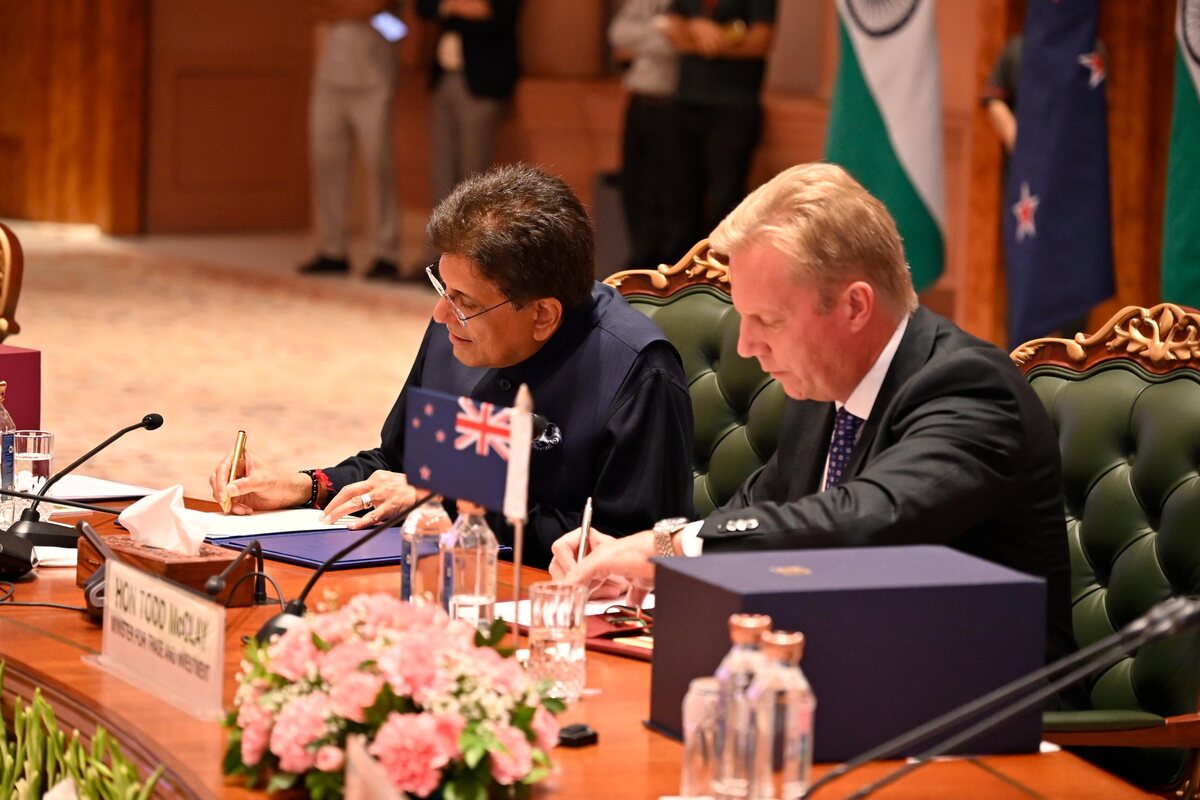
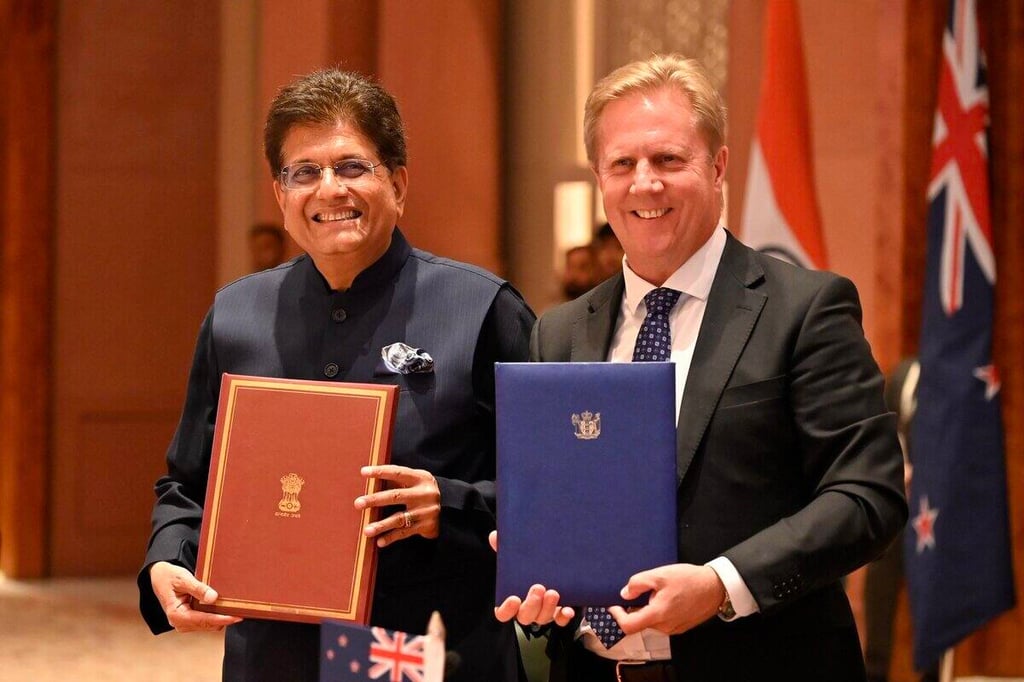
India and New Zealand signed on Monday a free trade deal, marking a new and significant chapter in their bilateral relationship.
The deal, signed by Union Minister of Commerce and Industry Shri Piyush Goyal and New Zealand’s Minister for Trade and Investment Hon. Todd McClay, reflects the two nations’ shared ambition to deepen engagement and their commitment to mutually beneficial growth.
New Zealand commits to $20 billion investment in India
Speaking on the signing, McClay called the India-New Zealand Free Trade Agreement a “once-in-a-generation” opportunity that will boost exports, create jobs and strengthen bilateral economic ties. He highlighted strong participation from New Zealand businesses at the signing and said the pact will improve market access, reduce trade barriers and support MSMEs.
He also emphasized deep people-to-people links, including the Indian diaspora’s contribution in New Zealand, and longstanding cultural and sporting ties. Describing India as a key partner in a changing global landscape, he expressed confidence that the agreement will deepen cooperation and deliver shared prosperity.
For his part, Union Minister for Commerce and Industry Shri Piyush Goyal said, “The India–New Zealand Free Trade Agreement marks a defining milestone in India’s engagement with the developed world. It reflects Prime Minister Narendra Modi’s vision of global economic partnerships for our farmers, women, youth, artisans and entrepreneurs.”
Notably, the deal marks India’s 9th agreement in the past few years with 38 developed countries. At the heart of the agreement is the empowerment for exports, agricultural productivity, student mobility, skills, investment and services.
“The investment commitment of $20 billion from New Zealand signals strong confidence in India’s growth story. It places special emphasis on strengthening MSMEs, fostering innovation and enabling women-led enterprises to thrive in global markets,” he added.
100 percent duty-free access to New Zealand market
The FTA provides duty-free access for 100 percent of India’s exports to New Zealand, covering all tariff lines, and is expected to significantly boost MSMEs and employment by enhancing competitiveness in labor-intensive sectors such as textiles, apparel, leather, footwear, gems and jewelry, engineering goods and processed foods.
Earlier, New Zealand maintained peak tariffs of up to 10 percent on key Indian exports, including ceramics, carpets, automobiles and auto components. With zero-duty market access from entry into force as New Zealand’s other trade partners, Indian products will be fully competitive in New Zealand, enjoying a level playing field, directly supporting workers, artisans, women entrepreneurs, youth, and MSMEs across India.
Significantly, India also secures duty-free inputs for its manufacturing sector, including wooden logs, coking coal, and waste and scraps of metals, lowering production costs and enhancing the global competitiveness of Indian industry.
In return, India has offered tariff liberalization on 70.03 percent of tariff lines covering 95 percent of bilateral trade value, while keeping 29.97 percent of tariff lines excluded to protect India’s sensitive sectors.
Bilateral merchandise trade hits $1.3 billion
Total trade in goods and services between the two nations reached $2.4 billion in 2024. India-New Zealand bilateral trade has shown strong growth in recent years, with bilateral merchandise trade in FY 2024-25 standing at $1.3 billion, registering a growth of 49 percent over the trade in the previous year.
With the FTA now signed, eliminating tariffs, enhancing services access, securing $20 billion in investment and establishing robust institutional frameworks, the India-New Zealand FTA is expected to boost bilateral trade significantly in the coming years, create employment opportunities, expand exports and strengthen a deeper and more resilient economic partnership between the two countries.