
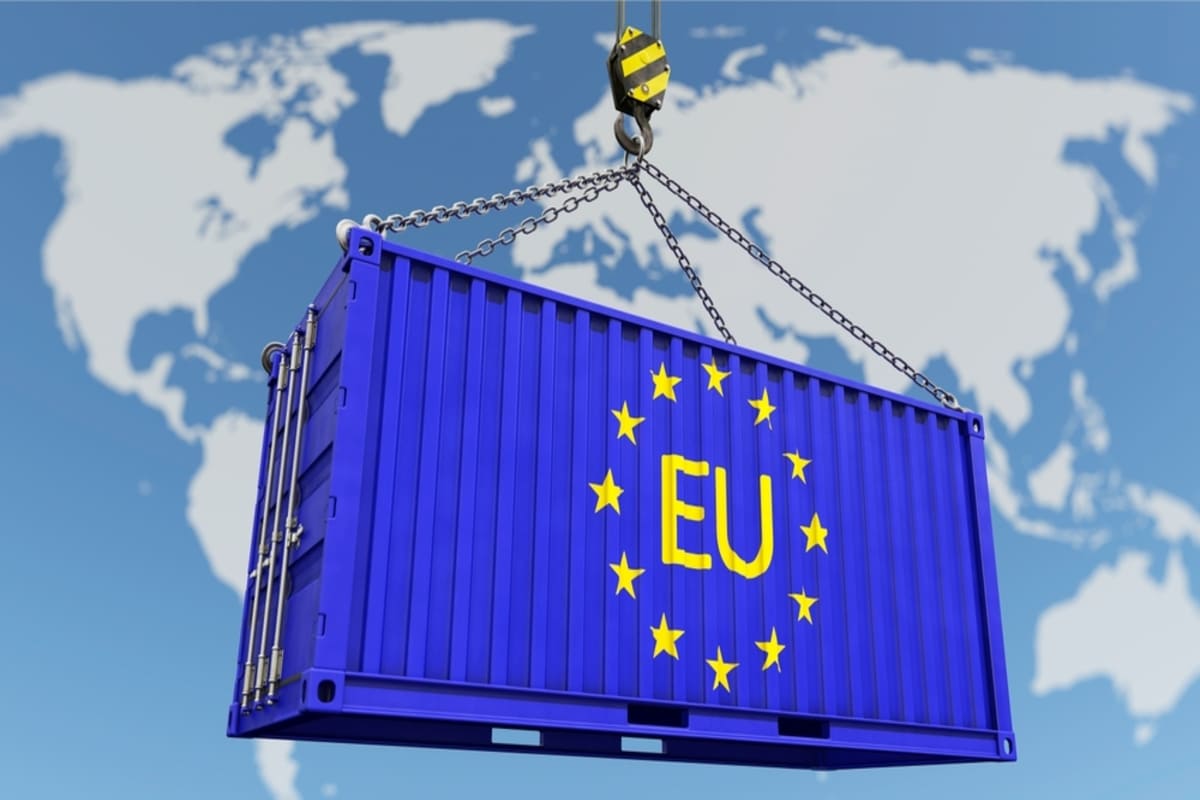
The euro area moved into a EUR7.8 billion ($8.9 billion) international trade deficit in May 2026 as imports increased considerably faster than exports, reversing the substantial surplus recorded during the same month last year.
First estimates published by Eurostat showed that the currency bloc’s trade in goods with the rest of the world shifted from a EUR15 billion surplus in May 2025. The latest result represented a year-on-year deterioration of EUR22.8 billion.
Exports from the euro area to markets outside the bloc reached EUR243.6 billion in May, edging up 0.1 percent from EUR243.5 billion a year earlier.
Imports climbed 10 percent to EUR251.4 billion, compared with EUR228.5 billion in May 2025. The increase in overseas purchases pushed imports above exports and produced the monthly deficit.
Eurostat attributed the deterioration primarily to a widening energy deficit, alongside smaller surpluses in machinery and vehicles and chemical and related products.
Surplus nearly disappears
The May result followed a EUR1.2 billion deficit in April 2026 on a non-seasonally adjusted basis, indicating that the euro area remained in negative territory for a second consecutive month.
Across the first five months of 2026, however, the euro area maintained a narrow goods trade surplus of EUR3.3 billion. That was substantially below the EUR78.7 billion surplus recorded between January and May 2025.
Exports to countries outside the euro area declined 2.8 percent over the five-month period to EUR1.2142 trillion, from EUR1.2498 trillion a year earlier.
Imports increased 3.4 percent to EUR1.2109 trillion, compared with EUR1.1711 trillion during the corresponding period of 2025. The combination of lower exports and higher imports reduced the cumulative surplus by EUR75.4 billion.
Trade among euro-area members continued to expand. Intra-euro-area trade rose 3.3 percent to EUR1.1567 trillion between January and May, up from EUR1.1196 trillion in the same period last year.
Read more: ECB selects 36 payment providers for 12-month digital euro pilot starting in 2027
EU records deficit
The wider European Union also recorded a deficit in its trade in goods with the rest of the world. The EU’s shortfall reached EUR12.1 billion ($13.8 billion) in May 2026, compared with a surplus of EUR12.7 billion one year earlier.
Extra-EU exports declined 1.1 percent to EUR215.7 billion from EUR218.2 billion, while imports surged 10.8 percent to EUR227.8 billion from EUR205.5 billion.
The change represented a EUR24.8 billion deterioration in the EU trade balance. As in the euro area, Eurostat said the decline was primarily caused by a larger energy deficit and reduced surpluses in machinery, vehicles and chemical products.
Between January and May, the EU recorded a cumulative trade deficit of EUR15.9 billion, reversing a EUR70.1 billion surplus in the same five months of 2025.
Extra-EU exports fell 4.8 percent to EUR1.0744 trillion, while imports increased 3 percent to EUR1.0903 trillion. Trade among EU members rose 4.3 percent to EUR1.8072 trillion.
Energy gap widens
A breakdown of the EU figures showed how energy trade contributed to the weaker overall balance. EU energy exports reached EUR13.2 billion in May, increasing 48.7 percent from a year earlier, but energy imports were considerably higher at EUR47.7 billion after rising 41.6 percent.
The resulting energy deficit widened to EUR34.5 billion from EUR24.8 billion in May 2025.
The EU continued to record a manufacturing surplus, although it narrowed sharply. Manufactured goods produced a EUR19.7 billion surplus, down from EUR36.1 billion a year earlier.
Chemical products generated a EUR16.6 billion surplus, compared with EUR22.9 billion in May 2025. Exports declined 12.6 percent to EUR45.5 billion, while imports slipped 1 percent to EUR28.9 billion.
The machinery and vehicles surplus contracted to EUR5 billion from EUR14.7 billion. Exports increased only 0.5 percent to EUR82.9 billion, while imports jumped 14.8 percent to EUR77.9 billion.
Other manufactured goods recorded a EUR2 billion deficit, compared with a EUR1.5 billion shortfall one year earlier.
Trading partner shifts
The EU maintained its largest surplus among the listed major partners with the United Kingdom, although the balance narrowed to EUR15.4 billion from EUR16.3 billion. Exports to the UK increased 2.1 percent to EUR29.9 billion, while imports rose 12.1 percent to EUR14.5 billion.
The surplus with the United States fell more sharply, reaching EUR7.9 billion compared with EUR18.4 billion in May 2025. EU exports to the US declined 12.3 percent to EUR40.8 billion, while imports increased 17.1 percent to EUR32.9 billion.
The trade deficit with China widened to EUR30.8 billion from EUR28 billion. EU exports to China declined 4.5 percent to EUR15.5 billion, while imports rose 4.9 percent to EUR46.3 billion.
Trade with Switzerland produced a EUR7.4 billion surplus, up from EUR4.7 billion, as exports increased 14.8 percent to EUR19.9 billion and imports declined 1.5 percent to EUR12.5 billion.
The EU recorded a EUR4.2 billion deficit with Norway, EUR2.3 billion with South Korea, EUR1.9 billion with India and EUR900 million with Brazil.
Adjusted data weakens
On a seasonally adjusted basis, Eurostat reported that euro-area exports increased 0.6 percent between April and May to EUR255.7 billion. Imports advanced more rapidly, rising 2.8 percent to EUR260.6 billion.
The seasonally adjusted euro-area balance consequently moved from a EUR0.8 billion surplus in April to a EUR5 billion deficit in May.
Seasonally adjusted EU exports rose 0.7 percent to EUR227.1 billion, while imports increased 2.5 percent to EUR236.2 billion. The EU deficit widened to EUR9 billion from EUR4.7 billion in April.
Over the three months from March through May, euro-area exports to markets outside the bloc increased 5 percent from the preceding three-month period. Imports grew 9.4 percent, nearly twice the pace of exports, while intra-euro-area trade advanced 4.6 percent.
EU exports rose 4.4 percent on the same basis, compared with a 10.3 percent increase in imports. Intra-EU trade expanded 4.8 percent.
Provisional trade estimates
The latest estimates cover the euro area’s 21 members, including Bulgaria, which joined the currency bloc before the May 2026 reporting period. The wider European Union figures cover all 27 member states.
Eurostat said the release was based on information submitted by national authorities before July 13, 2026, and cautioned that the figures remained provisional.
Under the EU methodology for international goods trade statistics, member states transmit monthly figures covering trade inside and outside the union. Estimates may be used when complete information is not yet available.
The national data are generally made available within 40 days of the end of the reference month, allowing Eurostat to publish euro-area and EU aggregates approximately 46 days after each reporting period.
Eurostat also adjusts the raw figures for seasonal and calendar effects. Goods are grouped according to the Standard International Trade Classification, covering categories such as food and drink, raw materials, energy, chemicals, machinery, vehicles and other manufactured goods.
The next euro-area and EU international trade release is scheduled for August 14, 2026.
For more news on the economy, click here.