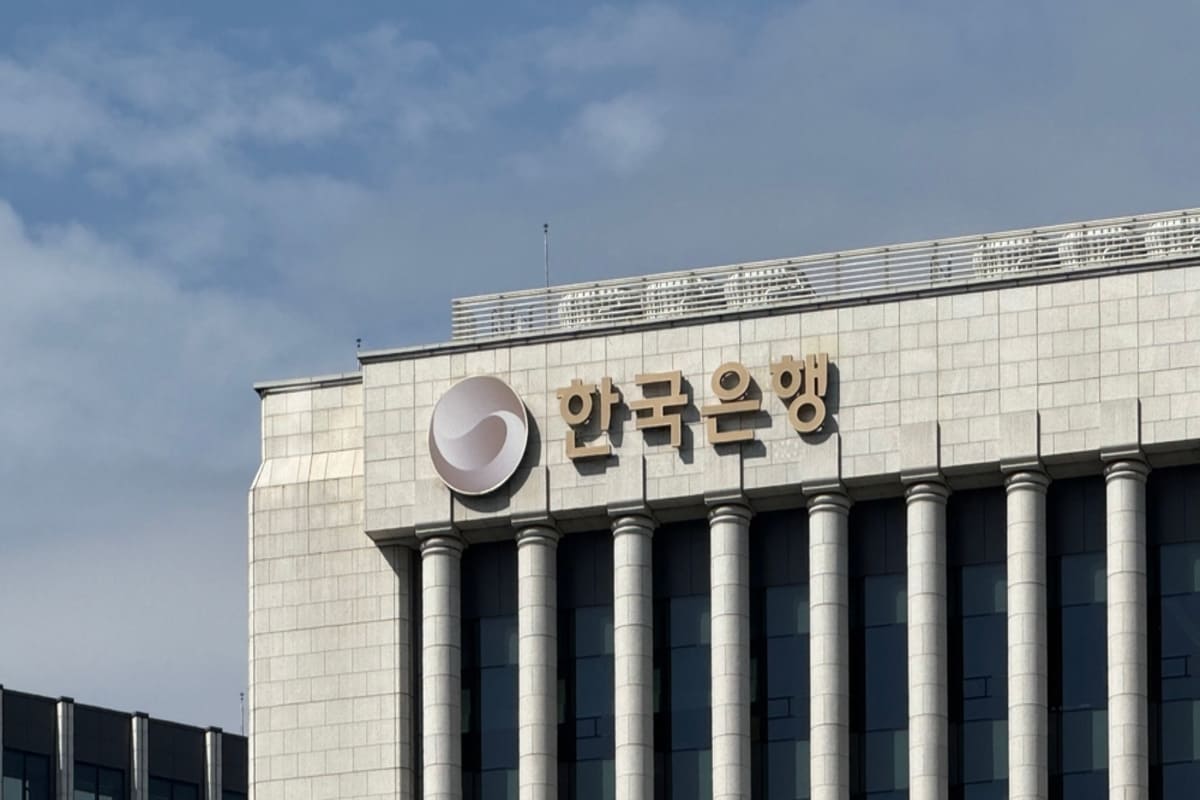
South Korea’s central bank raised its benchmark interest rate by a quarter percentage point on Thursday, delivering its first increase in three and a half years as policymakers responded to persistent inflation.
The Bank of Korea’s Monetary Policy Board unanimously voted to lift the base rate by 25 basis points from 2.5 percent to 2.75 percent, according to Yonhap News Agency.
The decision marked the central bank’s first rate increase since January 2023, when it raised borrowing costs by 0.25 percentage point to 3.5 percent as it continued normalizing monetary policy after measures intended to support the pandemic-hit economy.
The BOK subsequently began an easing cycle in October 2024, cutting the benchmark rate by a cumulative 100 basis points from 3.5 percent to support economic growth.
Before Thursday’s decision, the central bank had kept the policy rate unchanged at 2.5 percent since July 2025.
Inflation drives decision
The increase was widely anticipated after the BOK adopted a more hawkish position in the weeks preceding the meeting. At its previous policy meeting in May, the central bank held the benchmark rate steady for an eighth consecutive meeting.
The Monetary Policy Board said stronger economic growth, led by exports and investment, had reduced the need to maintain the previous level of monetary support. Inflation was also expected to remain above the central bank’s target for a considerable period, while risks to financial stability persisted.
All seven members of the board supported the decision to raise the policy rate, according to the BOK statement published by Yonhap.
Consumer price inflation accelerated to 3.2 percent in June from a year earlier, the fastest annual increase since December 2023. The figure followed a 3.1 percent rise in May, leaving headline inflation above 3 percent for a second consecutive month.
Petroleum product prices were a major contributor, rising 24.7 percent year on year in June as geopolitical tensions in the Middle East continued to affect oil prices and international supply chains. Core inflation, which excludes volatile food and energy prices, remained at 2.5 percent.
Currency risks persist
The central bank expects consumer price inflation to average approximately 2.7 percent in 2026, broadly matching its May projection. However, it said core inflation could exceed its previous forecast of 2.4 percent as stronger income conditions and domestic demand add to price pressures.
The Korean won also influenced the decision. It traded above 1,500 won against the U.S. dollar throughout June and briefly approached 1,550 on June 30, its weakest level since March 2009, amid broad dollar strength and continued foreign selling of South Korean equities.
The BOK said the won later recovered into the upper 1,400 range as foreign exchange market conditions improved. However, it identified continued currency volatility as one of the risks requiring close attention.
A weaker currency can increase the local cost of imported energy, raw materials and other goods, potentially adding to inflation in an economy heavily dependent on energy imports.
The central bank also pointed to accelerating housing prices in Seoul and surrounding areas, alongside a substantial increase in household borrowing. Both housing-related credit and other household loans increased, intensifying concerns about financial imbalances.
Read more: South Korea to inject $350 billion into U.S. AI, quantum computing, semiconductors
Growth outlook strengthens
South Korea’s economy has performed more strongly than previously expected, supported by semiconductor exports, artificial intelligence investment and improving consumption.
Exports reached a record $102.25 billion in June, rising 70.9 percent from a year earlier and surpassing $100 billion for the first time. Semiconductor shipments nearly tripled to a record $44.82 billion, according to Yonhap.
The economy expanded 1.8 percent during the first quarter, its fastest quarterly pace in almost six years. The government subsequently raised its 2026 economic growth forecast to 3 percent, the strongest projected annual expansion since 2021.
Bank of Korea Governor Shin Hyun Song said the central bank’s May growth projection of 2.6 percent had become too low because exports, investment and consumption were all performing strongly. The BOK is expected to revise its forecast when it publishes its next economic outlook in August.
The central bank nevertheless noted that employment remained uneven. The number of employed people increased because of gains in services, while employment continued to decline in important industries, including manufacturing.
Further hikes possible
The BOK indicated that Thursday’s move might not be the final increase in the current tightening phase. It said monetary policy would need to remain consistent with the possibility of further rate hikes while inflation stayed above target and financial stability risks remained elevated.
The timing and pace of any additional increases will depend on inflationary pressure, economic growth, the strength of domestic demand, housing prices, household debt and movements in the won.
Shin said policymakers would pay particular attention to second-quarter gross domestic product data and July inflation figures when assessing their next decision.
A majority of analysts surveyed by Reuters expected at least one more 25-basis-point increase before the end of 2026, which would take the policy rate to 3 percent. Median forecasts suggested the rate could reach 3.25 percent in the first quarter of 2027 and remain there through the end of that year, Reuters reported.
The BOK’s next monetary policy meeting is scheduled for August 27.
For more news on economy, click here.